Commercial HVAC Repair
Repairs for restaurants, offices, clinics and retail spaces, scheduled around business hours so your doors stay open.
Learn moreCooling
AC RepairAC InstallationAC ReplacementAC Tune-Up & MaintenanceRefrigerant Leak RepairAC Compressor ReplacementEvaporator Coil ReplacementAC Water Leak & Drain Line RepairHeating
Furnace RepairFurnace InstallationFurnace ReplacementFurnace Tune-Up & MaintenanceWall Furnace RepairFloor Furnace ReplacementBoiler & Radiant Heat RepairHeat Pumps & Ductless
Heat Pump RepairHeat Pump InstallationHeat Pump MaintenanceGas Furnace to Heat Pump ConversionDuctless Mini-Split InstallationDuctless Mini-Split RepairADU Heating & CoolingDucts & Attic
Duct RepairDuctwork ReplacementAir Duct CleaningDuct Sealing & Leak TestingWhole House Fan InstallationAttic InsulationIndoor Air
Indoor Air Quality TestingWhole-Home Air PurifiersUV Air SanitizersWhole-Home HumidifiersSystems & Commercial
Smart Thermostat InstallationHVAC Zoning SystemsFull HVAC System ReplacementHVAC InspectionHVAC Maintenance Plans24/7 Emergency HVAC RepairCommercial HVAC RepairCommercial HVAC MaintenanceRooftop & Package Unit RepairPasadena
Pasadena (all of the city)Bungalow HeavenMadison HeightsSan RafaelLinda VistaHastings RanchOak KnollAnnandaleProspect ParkHistoric HighlandsGarfield HeightsLamanda ParkSouth ArroyoChapman WoodsNearby cities
AltadenaSouth PasadenaSan MarinoArcadiaSierra MadreMonroviaDuarteGlendaleLa Canada FlintridgeLa CrescentaBurbankAlhambraSan GabrielTemple CityMonterey ParkRosemeadEl MonteAzusaGlendoraCovinaWest CovinaLos AngelesMontroseTujungaBaldwin ParkSouth El MonteMontebelloWhittierHacienda HeightsRowland HeightsLa PuenteWalnutDiamond BarSan DimasLa VerneClaremontPomonaUplandRancho CucamongaOntarioMontclairChino HillsBreaFullertonCounties
Los Angeles CountySan Bernardino CountyOrange CountySystems & Commercial in Pasadena, CA
Repairs on rooftop and ground-mounted package units: belts, contactors, economizers, compressors and gas heat sections.
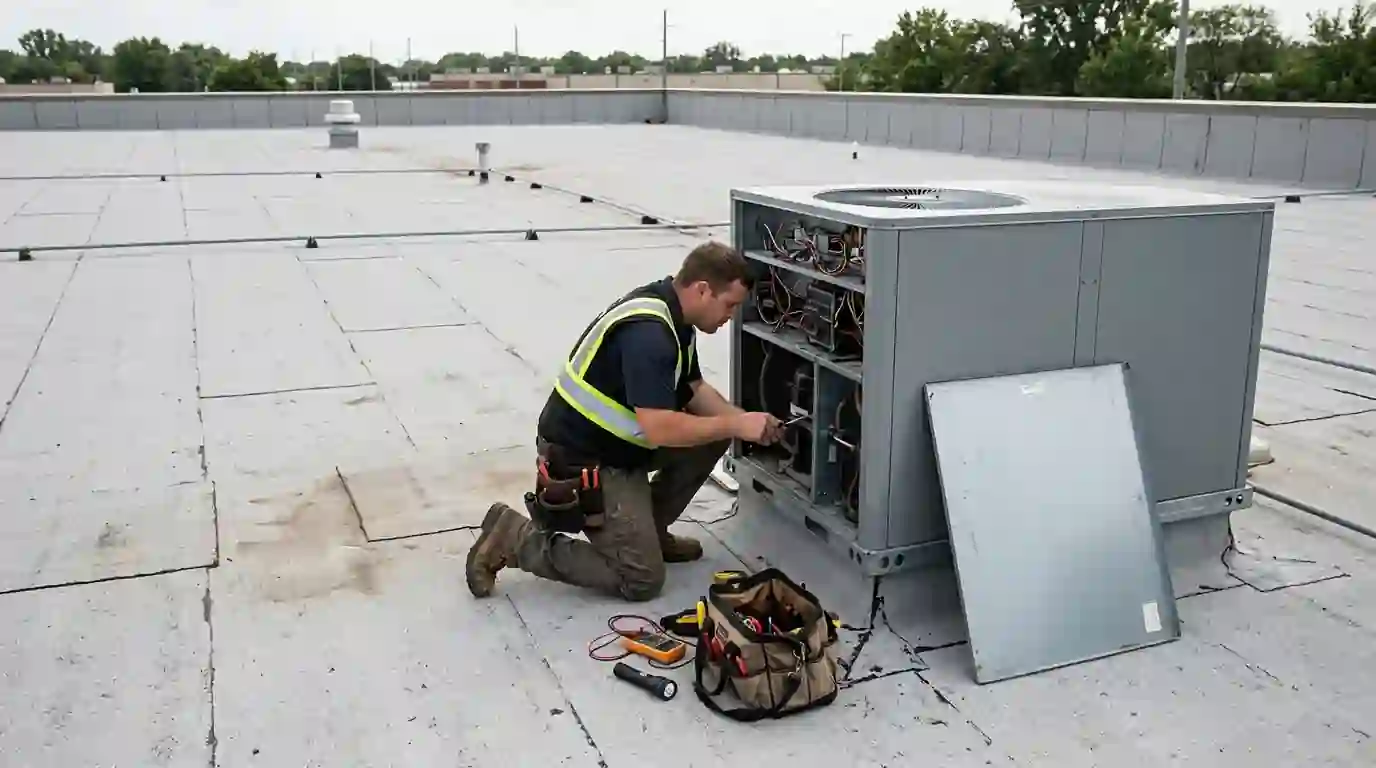
A package unit holds the compressor, coils, blower and often a gas heat section in one cabinet, usually on a roof or a ground pad. Common repairs are broken belts, burned contactors, failed capacitors, stuck economizers, condenser fan motors and clogged drains. Marco's technicians carry these parts. A typical rooftop unit repair in Pasadena runs $267 to $1,893 depending on the part. Call (626) 879-0711.
Rooftop & Package Unit Repair
Package units put everything in one box. The compressor, condenser coil, evaporator coil, blower, controls and, on gas-electric models, a furnace section all sit in a single cabinet, connected to the building through a roof curb or a wall. That design is compact and common on restaurants, offices, retail spaces, churches, and some homes and condos with flat roofs or side-yard pads. It also means one failed part can stop both heating and cooling at once.
Marco's repairs rooftop and ground-mounted package units for businesses and homeowners across Pasadena and nearby cities. Our technicians are used to roof hatches, fixed ladders and units on old curbs above older buildings. We diagnose with the unit's own fault codes and meters, explain the problem plainly, and give the price before repairs. Common parts like belts, contactors, capacitors and igniters ride on the truck. Call (626) 879-0711 any hour.
Warning signs
When the indoor blower moves air but the air stays warm, a compressor contactor, capacitor, high-pressure switch or low refrigerant charge is usually the cause. A condenser fan may also be out.
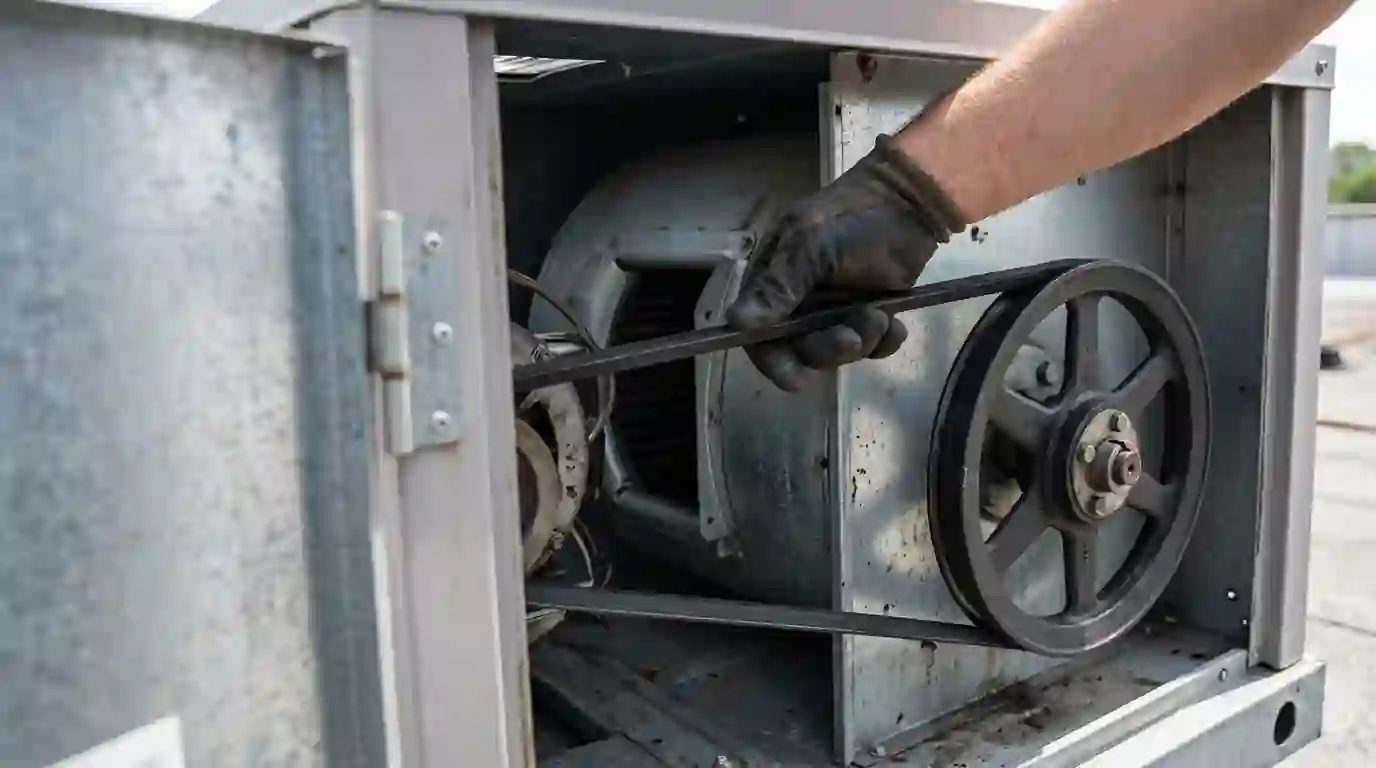
Belt-drive blowers squeal when the belt is glazed, loose or worn. If it breaks, airflow stops, and the compressor can freeze the coil before the unit shuts itself down.
Starting and stopping every few minutes can mean a dirty condenser coil tripping a high-pressure switch, a failing control board or a thermostat mounted in the wrong place.
Package units drain condensate through a trap on the cabinet. When the trap clogs or the pan overflows, water can follow the curb or duct into ceiling tiles or walls below.
Gas-electric package units have igniters, flame sensors, inducer motors and pressure switches like a furnace. Any of them failing stops heat on cold mornings.
If the space feels humid and warm whenever the unit runs, the economizer damper may be stuck open, pulling hot outside air instead of recirculating cooled indoor air.
Many commercial package units use a belt-driven blower. A motor turns a small pulley, a belt carries the power to a larger pulley on the blower wheel, and an adjustable motor pulley sets the airflow. Belts stretch and glaze with heat and run time, and a slipping belt cuts airflow long before it breaks. Bearings wear too, especially on units that run long hours. We check belt tension and alignment, inspect the pulleys for wear grooves, and listen to the bearings with the unit running.
Direct-drive units skip the belt but have their own wear points: motor bearings, run capacitors and the electronic module on variable-speed motors. Condenser fan motors on the top of the unit take full sun and heat all summer and are one of the most common failures we replace.
The contactor is an electrical switch that sends power to the compressor and condenser fan when the thermostat calls for cooling. Every start causes a small arc across its contacts, and after many seasons those contacts pit and burn until the compressor gets low voltage or none at all. Capacitors help motors start and run, and they lose strength with heat. On a hot roof, both wear faster than they would on a ground pad. They are among the quickest repairs we do.
Newer package units have control boards that log faults: high-pressure trips, low-pressure lockouts, flame failures and communication errors. Reading these codes points to the real problem, such as a dirty condenser coil causing high-pressure trips, rather than replacing parts by guesswork.
An economizer is a set of outside air and return air dampers, an actuator and a sensor. When the outdoor air is cool and dry enough, it opens to bring in outside air for cooling. On Pasadena's mild evenings and many spring days, that can carry the cooling load with little or no compressor time. When the actuator fails or the linkage sticks, the damper can stay open on a 100 degree afternoon, flooding the space with hot air. We test the actuator, the sensor, the minimum position and the linkage.
Gas-electric package units also have a heat section with a burner assembly, heat exchanger, inducer motor, pressure switch and flame sensor. Heating repairs follow furnace logic: check the ignition sequence, read the fault code, test each safety, and inspect the heat exchanger and venting.
A failed compressor is the most expensive repair on a package unit. Before condemning one, we check the capacitor, contactor, wiring and windings, because a compressor that will not start sometimes only needs a new start component. When the compressor is truly gone, the decision depends on the unit's age, refrigerant type and overall condition. Replacing a compressor in an older R-22 or worn R-410A unit can cost a large share of a new unit. We lay out both repair and replacement prices so you can decide with clear numbers.
Step by step
We ask where the roof hatch or ladder is and whether a key or escort is needed, then arrive with the right ladder and the common parts for your unit type.
On the roof, the technician reads fault codes, checks power at the disconnect, and watches the unit start to see which section fails and how it behaves.
Contactors, capacitors, motors, belts, pressures and safety switches are tested with meters and gauges. The economizer and heat section are checked when the symptoms point there.
You get a plain explanation of what failed and the repair price before work starts. For a major failure, we include a replacement comparison with the price.
After the repair, we run the unit through cooling and heating cycles, check supply air temperatures inside the space and confirm the drain and panels are secure.
Typical prices
Rooftop repairs cost more than ground-level work when access is difficult, because the technician carries parts and tools up a ladder or through a hatch. Costs also depend on unit size and refrigerant type. These are typical 2026 ranges in the Pasadena area. We quote the price before we start the work.
| Job | Typical range | What is included |
|---|---|---|
| Belt replacement and adjustment | $167 to $319 | Includes tension and alignment check, multiple belts on larger blowers |
| Contactor or capacitor replacement | $267 to $547 | Common hot weather failure, usually completed on the first visit |
| Economizer actuator or sensor | $437 to $1,189 | Depends on actuator type, controller and damper linkage condition |
| Condenser fan motor | $593 to $1,437 | Motor, blade check and capacitor, priced by horsepower and model |
| Compressor replacement | $2,987 to $6,843 | Depends on tonnage, refrigerant and access, compared with unit replacement |
Roofs without fixed ladders, tall buildings, crane lifts for heavy parts, after-hours work and older units with discontinued parts raise the price. Refrigerant leak repairs are priced separately once the leak is located. Compare other jobs in our Pasadena HVAC price guide.
Pasadena has package units on buildings of every era. Old Pasadena's brick buildings from the early 1900s and 1920s often carry rooftop units added decades later, on curbs built into older roofs. Strip retail along Colorado Boulevard, Lake Avenue and Foothill Boulevard usually has one unit per tenant space. Some postwar homes and condos in the San Gabriel Valley have package units on flat roofs or on side-yard pads, because there was no room for a furnace inside. Each setting brings its own access and service challenges.
A rooftop unit in Pasadena's summer heat sits above a roof surface much hotter than the air, and condenser coils collect dust from Santa Ana winds and ash during smoke events. Spring and fall maintenance catches much of this before a breakdown. Commercial customers get electricity from Pasadena Water and Power in the city and from SCE in most nearby cities, and gas service comes from SoCalGas for units with gas heat.
Related work
Repairs for restaurants, offices, clinics and retail spaces, scheduled around business hours so your doors stay open.
Learn moreScheduled visits, filter programs and belt checks for rooftop units and split systems in restaurants, offices and retail spaces.
Learn moreWe trace refrigerant leaks with electronic detectors, bubble tests and nitrogen pressure, then repair and recharge by weight.
Learn moreWe test windings, start components and pressures to confirm a dead compressor, then replace it and protect the new one from the same fate.
Learn moreOur technicians handle this work all over Pasadena and the surrounding San Gabriel Valley. A few of the places we cover:
Questions
Yes. Some homes and condos in Pasadena and nearby cities have package units on flat roofs or side-yard pads, especially postwar buildings and townhomes. The repairs are the same as on commercial units: contactors, capacitors, motors, drains and gas heat sections. Residential units are usually smaller and direct-drive. We confirm roof access and HOA requirements before the visit when needed.
Package units freeze when too little air crosses the indoor coil or the refrigerant charge is low. Common causes are a broken or slipping blower belt, a clogged filter, a failed blower motor or a refrigerant leak. Turn off cooling and run the fan to thaw the coil, then call us. Running a frozen unit can send liquid refrigerant back to the compressor and damage it.
It depends on age, refrigerant and condition. A unit under about 10 years old in good shape is often worth repairing. An older R-22 unit or a worn R-410A unit with rusted cabinets and tired coils is usually better replaced, because a compressor costs a large share of a new unit. We give you both prices so you can compare.
If the economizer damper sticks open during a hot afternoon, the unit pulls in outside air near 100 degrees instead of recirculating cooled indoor air. The space stays warm and humid, and the compressor runs nonstop. Stuck closed, it wastes free cooling on cool evenings. We test the actuator, sensor and linkage and set the minimum position correctly.
Most repairs do not need a crane, because belts, motors, contactors, capacitors and controls are carried up by hand. Compressor replacements on larger units, or full unit replacement, may need a crane, especially on taller buildings. If a crane is required, we include it in the quote, plan the lift with the building owner and schedule it for a quiet time.
Call our Pasadena line any hour. A person answers, asks a few questions about the system, and gives you an arrival window.