Heat Pump Maintenance
A two-mode tune-up for Pasadena heat pumps: coil cleaning, electrical tests, defrost checks, drain flushing and a clear report on condition.
Learn moreCooling
AC RepairAC InstallationAC ReplacementAC Tune-Up & MaintenanceRefrigerant Leak RepairAC Compressor ReplacementEvaporator Coil ReplacementAC Water Leak & Drain Line RepairHeating
Furnace RepairFurnace InstallationFurnace ReplacementFurnace Tune-Up & MaintenanceWall Furnace RepairFloor Furnace ReplacementBoiler & Radiant Heat RepairHeat Pumps & Ductless
Heat Pump RepairHeat Pump InstallationHeat Pump MaintenanceGas Furnace to Heat Pump ConversionDuctless Mini-Split InstallationDuctless Mini-Split RepairADU Heating & CoolingDucts & Attic
Duct RepairDuctwork ReplacementAir Duct CleaningDuct Sealing & Leak TestingWhole House Fan InstallationAttic InsulationIndoor Air
Indoor Air Quality TestingWhole-Home Air PurifiersUV Air SanitizersWhole-Home HumidifiersSystems & Commercial
Smart Thermostat InstallationHVAC Zoning SystemsFull HVAC System ReplacementHVAC InspectionHVAC Maintenance Plans24/7 Emergency HVAC RepairCommercial HVAC RepairCommercial HVAC MaintenanceRooftop & Package Unit RepairPasadena
Pasadena (all of the city)Bungalow HeavenMadison HeightsSan RafaelLinda VistaHastings RanchOak KnollAnnandaleProspect ParkHistoric HighlandsGarfield HeightsLamanda ParkSouth ArroyoChapman WoodsNearby cities
AltadenaSouth PasadenaSan MarinoArcadiaSierra MadreMonroviaDuarteGlendaleLa Canada FlintridgeLa CrescentaBurbankAlhambraSan GabrielTemple CityMonterey ParkRosemeadEl MonteAzusaGlendoraCovinaWest CovinaLos AngelesMontroseTujungaBaldwin ParkSouth El MonteMontebelloWhittierHacienda HeightsRowland HeightsLa PuenteWalnutDiamond BarSan DimasLa VerneClaremontPomonaUplandRancho CucamongaOntarioMontclairChino HillsBreaFullertonCounties
Los Angeles CountySan Bernardino CountyOrange CountyHeat Pumps & Ductless in Pasadena, CA
Diagnosis and repair for heat pumps that will not heat, will not cool, ice up, trip breakers or show inverter fault codes.
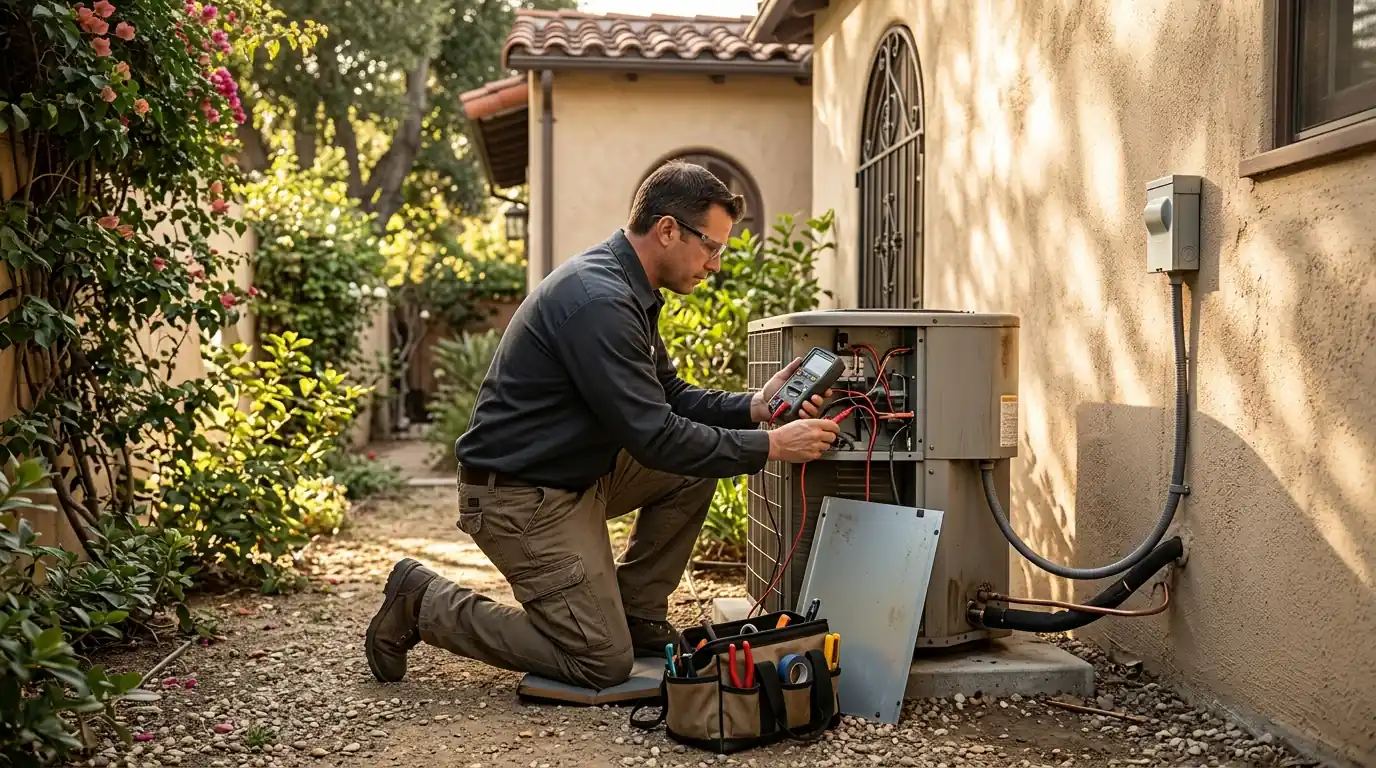
Most heat pump problems in Pasadena come down to a small set of parts: the run capacitor, the contactor, the reversing valve and its solenoid, the defrost controls, the inverter board, or a slow refrigerant leak. A Marco's technician tests the system in both heating and cooling, finds the failed part, and quotes the repair before any work starts. Call (626) 879-0711 any hour.
Heat Pump Repair
A heat pump is an air conditioner that can run backward. One refrigerant circuit, one compressor and one outdoor coil do both jobs, so a single failed part can take away your cooling in August and your heat in January. That is also why heat pump repair needs a different approach from straight AC repair. The technician has to test the system in both directions, read the control board, and confirm that the valve that switches modes is actually moving refrigerant the way the thermostat is asking.
Marco's Heating & Air repairs ducted heat pumps, packaged rooftop heat pumps and inverter-driven systems across Pasadena and the San Gabriel Valley. We answer the phone 24/7, carry the common capacitors, contactors, fan motors and sensors on the truck, and explain what we found in plain terms. If the unit is near the end of its life, we tell you that too, with the repair price next to the replacement price so you can choose.
Warning signs
The fan runs and the outdoor unit hums, but the vents blow room temperature air. This often points to a stuck reversing valve, a bad solenoid coil, or a thermostat wired for the wrong valve logic.
A light frost on a cold Pasadena morning is normal. A solid sheet of ice that does not clear within about an hour suggests a defrost control fault, a failed sensor, or low refrigerant.
A compressor that pulls hard when it starts can trip the breaker. Weak start components, a shorted fan motor, or loose wiring at the disconnect are common causes worth checking before the compressor is blamed.
Inverter heat pumps report faults through blinking LEDs or codes on the outdoor board. The code narrows the search, but it still needs a meter reading to confirm which part failed.
A short whoosh when the system switches modes is normal. Grinding, rattling or a repeated hard clunk can mean a failing fan motor bearing, a loose blade, or a compressor mount that has worn.
If your PWP or SCE bill climbs while your habits stay the same, the heat pump may be running longer to make up for low charge, a dirty coil, or electric backup heat that is staying on.
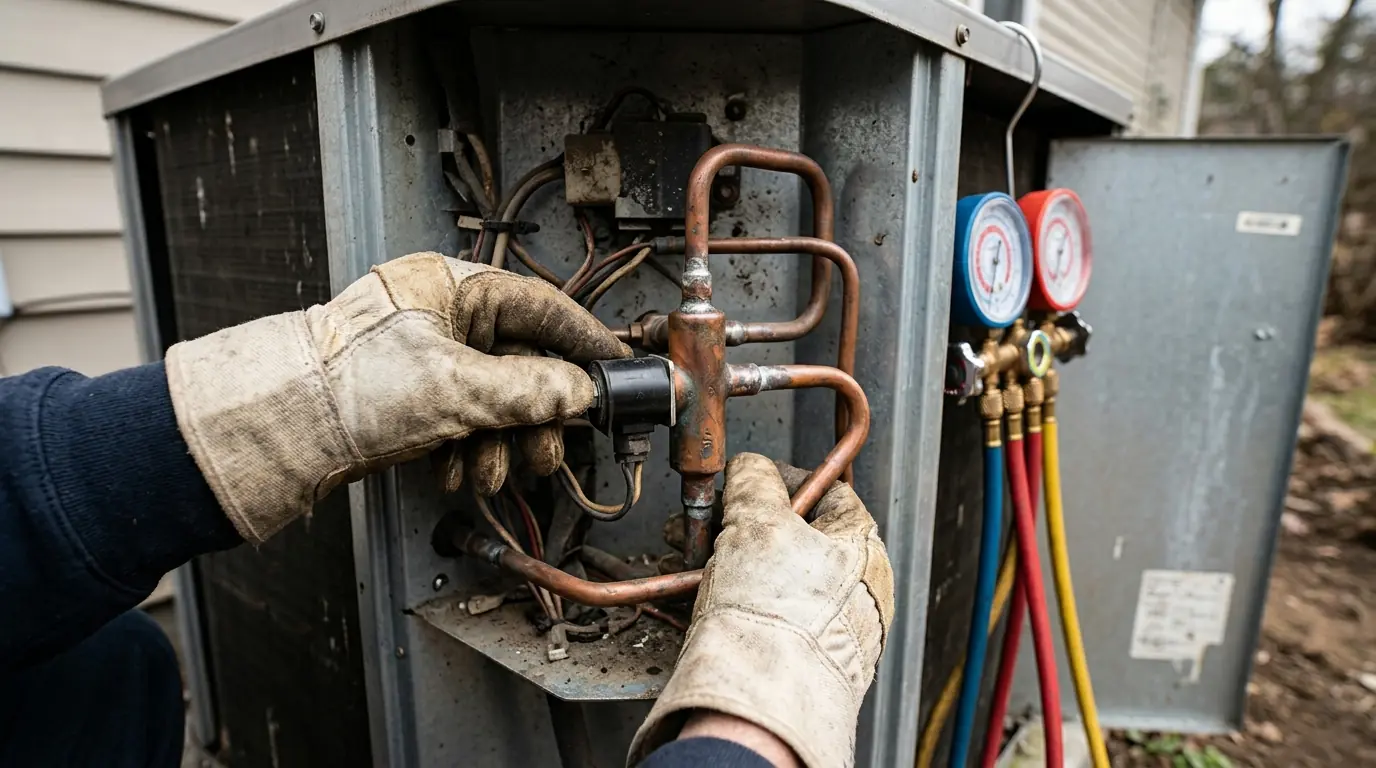
The reversing valve is the part that makes a heat pump different. It is a four-way valve with a sliding piston, moved by refrigerant pressure when a small electric solenoid on its side is powered. Most systems power that solenoid in cooling mode and let it rest in heating, though a few designs do the opposite. When a homeowner or handyman swaps the thermostat and picks the wrong setting, the system heats when you ask for cooling. When the piston sticks or the solenoid coil burns out, it gets locked in one mode.
Defrost controls are the next suspect. In heating mode the outdoor coil runs colder than the outside air, so moisture freezes on it. The defrost board watches a coil sensor and a timer, then briefly flips the system into cooling to melt the ice. In Pasadena's mild winters that happens only on the coldest nights, which means a bad defrost board can hide for years until a cold snap in the 30s shows it.
Many heat pumps installed in the last ten years use an inverter compressor. Instead of switching between full speed and off, the compressor changes speed to match the load. That makes them quiet and efficient, but it also means the outdoor unit has a control board that converts power, reads several temperature sensors, and talks to the indoor unit over a communication wire.
When one of those sensors drifts, the board can slow the compressor down or shut it off to protect itself, and the house just feels like the system cannot keep up. Our technicians check sensor resistance against the manufacturer chart, read the stored fault history, and confirm voltage at the board before replacing anything. A board is an expensive part, so we want to be sure before we order one.
A heat pump runs the same refrigerant through the coils in both directions, and it is sensitive to being slightly over or under charged. Low charge shows up first as weak heating on cold mornings and a coil that ices too often, then as poor cooling on the first 100 degree day. Adding refrigerant without finding the leak only buys a few months.
We look for oil stains at the flare nuts and service valves, check the outdoor coil for rub points against the cabinet, and use an electronic detector or bubble solution on suspect joints. If the leak is in a coil, we price the coil replacement and the full system replacement side by side, because on an older unit the numbers can be close.
Step by step
We ask when the problem started, which mode it affects, what the thermostat shows, and whether anything changed recently, such as a new thermostat, a power outage, or a Santa Ana wind day.
The technician runs the system in cooling and in heating, measures temperatures at the supply and return, and watches the reversing valve switch so nothing is assumed from one mode alone.
Capacitor values, contactor condition, voltage at the disconnect, fan motor amps and any inverter board codes get checked with a meter, because many heat pump faults are electrical first.
You get the cause, the part, and a price before we start. If replacement makes more sense on an older system, we show you both numbers and let you decide.
After the repair, the system runs through a full cycle in both modes, and we force a defrost test where the board allows it, so you know the fix holds.
Typical prices
These are typical 2026 ranges we see on Pasadena and San Gabriel Valley heat pumps. The final price depends on the brand, the part, how hard the unit is to reach, and what the technician finds once the panels are off. We quote the price before we start the work.
| Job | Typical range | What is included |
|---|---|---|
| Diagnostic visit with both-mode testing | $119 to $217 | Covers testing in heating and cooling, electrical checks and a written finding |
| Capacitor or contactor replacement | $187 to $463 | The most common summer repair, usually fixed the same visit from truck stock |
| Defrost board or coil sensor | $312 to $687 | Varies with brand and whether the board is universal or factory specific |
| Reversing valve replacement | $1,180 to $2,740 | Requires recovering refrigerant, brazing the new valve, evacuating and recharging |
| Inverter control board | $689 to $1,935 | Factory parts only; price depends heavily on the manufacturer and unit size |
Price moves with refrigerant type and amount, parts availability for older models, rooftop or tight side yard access, and after-hours timing. Manufacturer parts warranties can lower the cost when the equipment was registered. Compare other jobs in our Pasadena HVAC price guide.
Pasadena heat pumps work much harder at cooling than at heating. A long run of high 90s and 100 degree days in July and August cooks capacitors and fan motors, and that is when most of our heat pump repair calls come in. The opposite is true for defrost parts. On the flats near Old Pasadena or Lamanda Park, a heat pump may only defrost a handful of times a winter, while homes up toward the foothills in Altadena or Linda Vista see colder, clearer nights and more defrost cycles.
Dust and smoke matter here too. Santa Ana wind days pack fine dust into outdoor coils, and the smoke and ash from the Eaton Fire left residue on many units in Altadena and east Pasadena. A coated coil makes the compressor run hotter and longer, which shortens the life of everything in the cabinet. When we repair a unit that has been through that, we check and clean the coil as part of the visit so the new part is not working against it.
Related work
A two-mode tune-up for Pasadena heat pumps: coil cleaning, electrical tests, defrost checks, drain flushing and a clear report on condition.
Learn moreNew ducted and inverter heat pumps sized to your Pasadena home, with permits, line sets, electrical and duct checks included in the quote.
Learn moreWe trace refrigerant leaks with electronic detectors, bubble tests and nitrogen pressure, then repair and recharge by weight.
Learn moreNight, weekend and holiday repairs for a dead AC in a heat wave or a furnace that quits on a cold night, any hour.
Learn moreOur technicians handle this work all over Pasadena and the surrounding San Gabriel Valley. A few of the places we cover:
Questions
The most common causes are a reversing valve that is stuck in cooling, a burned out solenoid coil on that valve, or a thermostat set up for the wrong valve logic after a replacement. During a defrost cycle the indoor air can also feel cool for a few minutes, which is normal. If it lasts longer than about ten minutes, call (626) 879-0711 and we will test the valve and the controls.
It depends on the part. A capacitor, contactor or fan motor is usually worth fixing on any age of unit. A reversing valve, compressor or coil on a system that old often costs a large share of a new one. We give you the repair price and a replacement price on the same visit, so you can compare them with your own budget and plans.
Far less often than in colder places. Most Pasadena heat pumps only defrost on nights that drop near freezing with some moisture in the air, and many winters bring only a few of those. That is why a failed defrost board can go unnoticed. If you see heavy ice that stays on the outdoor coil for over an hour, the defrost controls need checking.
Often, yes. Capacitors, contactors, many fan motors, sensors and thermostat wiring fixes are handled the same visit from parts on the truck. Factory inverter boards, reversing valves and some motors for older or less common models have to be ordered, which usually takes a few business days. We tell you the timing before you approve the work.
Only if the system is low or the repair opens the sealed circuit, such as a valve or coil replacement. Older heat pumps used R-22, which is now scarce and expensive. Most units from the 2010s use R-410A, and newer ones use lower impact refrigerants. The technician checks the nameplate and quotes the refrigerant cost as part of the repair price.
Call our Pasadena line any hour. A person answers, asks a few questions about the system, and gives you an arrival window.