Ductwork Replacement
New attic ductwork sized for your rooms and equipment, sealed with mastic and leak tested before we call the job done.
Learn moreCooling
AC RepairAC InstallationAC ReplacementAC Tune-Up & MaintenanceRefrigerant Leak RepairAC Compressor ReplacementEvaporator Coil ReplacementAC Water Leak & Drain Line RepairHeating
Furnace RepairFurnace InstallationFurnace ReplacementFurnace Tune-Up & MaintenanceWall Furnace RepairFloor Furnace ReplacementBoiler & Radiant Heat RepairHeat Pumps & Ductless
Heat Pump RepairHeat Pump InstallationHeat Pump MaintenanceGas Furnace to Heat Pump ConversionDuctless Mini-Split InstallationDuctless Mini-Split RepairADU Heating & CoolingDucts & Attic
Duct RepairDuctwork ReplacementAir Duct CleaningDuct Sealing & Leak TestingWhole House Fan InstallationAttic InsulationIndoor Air
Indoor Air Quality TestingWhole-Home Air PurifiersUV Air SanitizersWhole-Home HumidifiersSystems & Commercial
Smart Thermostat InstallationHVAC Zoning SystemsFull HVAC System ReplacementHVAC InspectionHVAC Maintenance Plans24/7 Emergency HVAC RepairCommercial HVAC RepairCommercial HVAC MaintenanceRooftop & Package Unit RepairPasadena
Pasadena (all of the city)Bungalow HeavenMadison HeightsSan RafaelLinda VistaHastings RanchOak KnollAnnandaleProspect ParkHistoric HighlandsGarfield HeightsLamanda ParkSouth ArroyoChapman WoodsNearby cities
AltadenaSouth PasadenaSan MarinoArcadiaSierra MadreMonroviaDuarteGlendaleLa Canada FlintridgeLa CrescentaBurbankAlhambraSan GabrielTemple CityMonterey ParkRosemeadEl MonteAzusaGlendoraCovinaWest CovinaLos AngelesMontroseTujungaBaldwin ParkSouth El MonteMontebelloWhittierHacienda HeightsRowland HeightsLa PuenteWalnutDiamond BarSan DimasLa VerneClaremontPomonaUplandRancho CucamongaOntarioMontclairChino HillsBreaFullertonCounties
Los Angeles CountySan Bernardino CountyOrange CountyDucts & Attic in Pasadena, CA
We find crushed, torn and disconnected attic ducts, fix them with mastic and new flex, and check airflow before we leave.
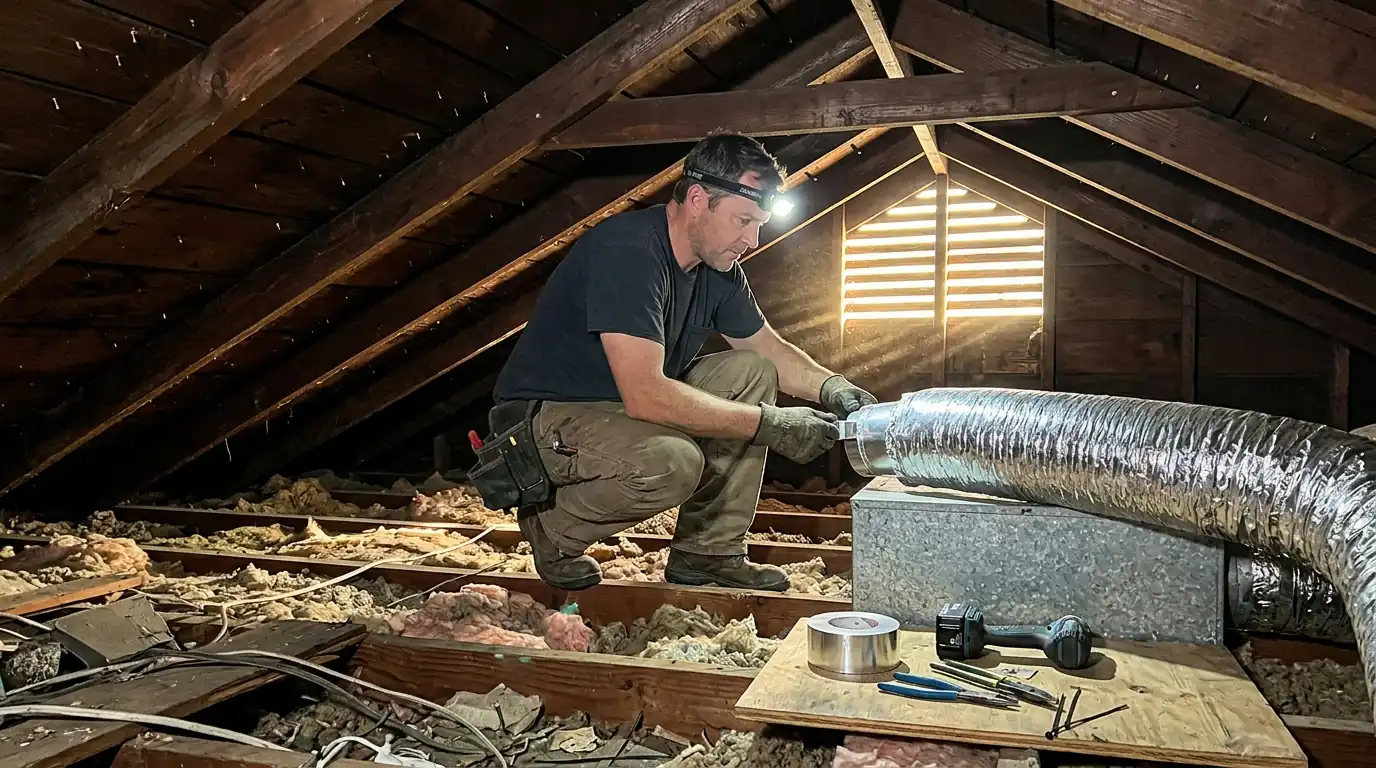
Most duct problems in Pasadena homes are up in the attic: flex duct that has slipped off a fitting, runs crushed flat by foot traffic, or tape that let go in summer heat. A technician finds the leak or blockage, reconnects or replaces the damaged section, seals the joints with mastic and checks airflow at each register. Small repairs are usually done in one visit.
Duct Repair
When one bedroom never cools down, or the AC runs all afternoon and the house still feels stuffy, the ducts are often the reason. In a typical Pasadena attic the supply runs are flexible duct: a plastic inner liner, a blanket of fiberglass and an outer vapor jacket. That material is light and easy to install, but it does not hold up well to being stepped on, pulled tight, or baked for years under a dark roof. A single disconnected run can dump cool air into the attic for months before anyone notices.
Marco's technicians crawl the attic, follow each run from the plenum to the register, and look for the specific failure rather than guessing. We reconnect runs that have slipped off their collars, replace sections that are crushed or torn, fix boots that have pulled away from the ceiling, and seal joints with mastic so they stay put. You get a plain explanation of what we found, with photos when that helps, and the price before any work starts. Call (626) 879-0711, day or night.
Warning signs
A back bedroom or upstairs room that stays several degrees warmer than the rest of the house often points to a crushed, kinked or disconnected run feeding that room.
If you hold your hand to a supply register and feel only a faint breath while others blow hard, the duct behind it may be pinched, torn or partly off its fitting.
A PWP or SCE bill that climbs while your habits stay the same can mean cooled air is leaking into the attic, so the AC runs longer to reach the setpoint.
Leaky return ducts in the attic or garage pull in insulation fibers, attic dust and Santa Ana grit, so furniture gets dusty again a day or two after cleaning.
A whistle near a register, or a flapping noise above the ceiling when the blower starts, can come from a loose boot, a torn liner or a fitting barely holding on.
A warm, dusty or musty smell from the vents when the system starts often means the return is drawing air from the attic or a wall cavity instead of the house.
Flex duct is held to a metal collar with a plastic tie strap and sealant. Over time the strap loosens, the inner liner shrinks back, and the run slides off. In attics that get far hotter than the outdoor air on July afternoons, cheap cloth duct tape dries out and lets go within a few seasons. Runs that were pulled tight around a corner flatten at the bend, and runs left lying across joists sag between supports, which chokes airflow just like a kink.
People also damage ducts without knowing it. Cable and solar installers, pest control crews and roofers walk the attic and step on runs. Rodents chew through the outer jacket and nest in the insulation. In older homes, a register boot that was screwed to the ceiling decades ago can pull loose as the house settles, leaving a gap that blows straight into the attic.
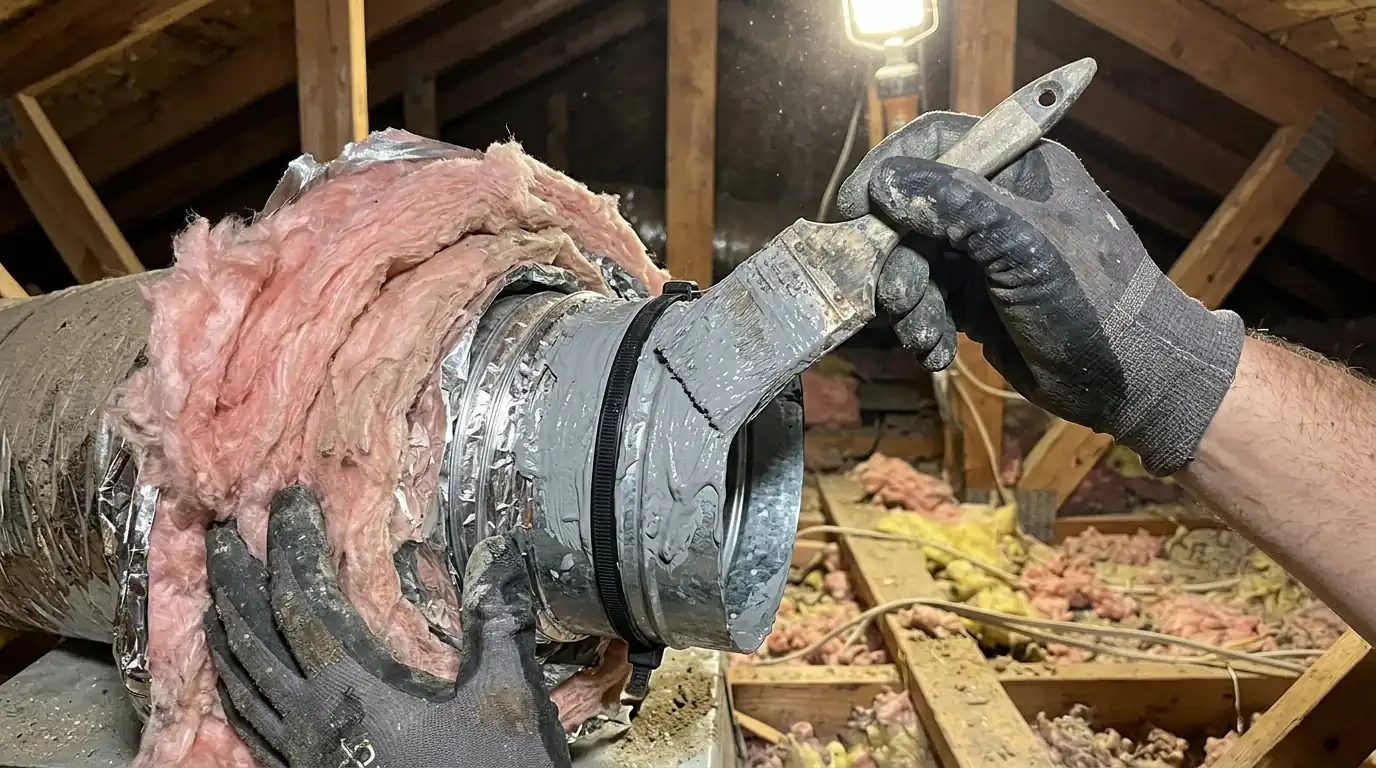
A good repair is more than a new piece of tape. We pull the inner liner over the collar, secure it with a tension-rated tie strap, and coat the joint with water-based mastic. Then the insulation and outer jacket are pulled over the joint and strapped separately, so there is no bare metal sweating in the attic. Crushed sections are cut out and replaced with new R-8 flex of the correct diameter, joined with a metal coupling.
We also fix the route. Runs get strapped with wide hangers every few feet so they do not sag, sharp bends are opened up into gentle curves, and runs that cross walkways are moved or protected. If a section of rigid metal duct has opened at a seam, we fasten it with screws and mastic. Before leaving, we check airflow at the registers we worked on and compare it with the rest of the house.
Sometimes the honest answer is that the ducts are past fixing. If most of the runs are original 1980s or 1990s flex with a crumbling outer jacket, if the insulation value is far below what the attic needs, or if we find damage on nearly every run, patching one or two spots just moves the problem around. In that case we explain the difference in cost between repairing and replacing so you can decide.
In homes built before 1980 we sometimes find old metal duct wrapped in gray or white paper, or joints sealed with an off-white fibrous tape. That material may contain asbestos. We do not cut, scrape or move it. We recommend having a small sample tested by a lab before anyone works on that section, and we plan the repair around the result.
Step by step
We ask which rooms feel wrong, when it started and whether anyone has worked in the attic recently. That narrows down where to look before the technician goes up.
The technician follows each duct from the plenum to the register, checking connections, straps, the outer jacket and any crushed or kinked spots, and photographs what matters.
You get a clear list of what needs fixing and the price for each item before work starts. Nothing is added later without your say.
Damaged sections are cut out or reconnected, joints are sealed with mastic, runs are strapped and rerouted, and boots are fastened and sealed at the ceiling.
We run the system, feel and measure the air at the repaired registers, and show you before and after photos so you can see the difference.
Typical prices
Duct repair pricing depends mostly on how many runs are damaged and how hard the attic is to work in. A single reconnect near the attic hatch is quick. Several crushed runs at the far end of a low Craftsman attic take longer. These are typical ranges, and the final price comes after the technician sees the system.
| Job | Typical range | What is included |
|---|---|---|
| Reconnect and seal one loose run | $187 to $364 | New tie strap, mastic and insulation pulled back over the joint |
| Replace one damaged flex section | $342 to $689 | New R-8 flex, coupling and straps; longer runs or tight attics cost more |
| Repair several runs in one visit | $617 to $1,385 | Typical when installers or rodents damaged multiple runs across the attic |
| Reseal and fasten a register boot | $128 to $276 | Boot fastened to framing and sealed where it meets the ceiling or floor |
Price moves with attic height and access, how far the damage is from the hatch, duct diameter, whether insulation or debris has to be moved first, and whether old material needs lab testing before we touch it. Compare other jobs in our Pasadena HVAC price guide.
Pasadena has a lot of older homes that never had ducts when they were built. Craftsman bungalows in neighborhoods like Bungalow Heaven and Madison Heights often started with a floor furnace or wall furnace, and ducts were added to the attic later when central air came in. Those retrofits were sometimes done fast, with long runs snaked across low attics and few straps. The attic over a bungalow can be tight, with only a couple of feet of clearance near the edges, so damage tends to collect where it was hardest to reach.
Postwar ranch homes in Hastings Ranch, Lamanda Park and Chapman Woods usually have more room overhead, but their ducts are older and often on their second or third set of flex. Inland heat matters too. When afternoons run into the high 90s and above 100 F, the attic gets much hotter than that, and weak tape, old flex and loose boots fail faster. We schedule attic work for mornings in summer when we can, which is safer for the technician and better for the materials.
Related work
New attic ductwork sized for your rooms and equipment, sealed with mastic and leak tested before we call the job done.
Learn moreWe measure duct leakage with a calibrated fan, seal joints with mastic, and test again so you see the actual improvement.
Learn moreAir sealing first, then blown-in insulation to the right depth, so your ceilings stop radiating attic heat into the rooms.
Learn moreWarm air, a humming outdoor unit or a tripped breaker: we find the failed part and fix most AC problems in one visit.
Learn moreOur technicians handle this work all over Pasadena and the surrounding San Gabriel Valley. A few of the places we cover:
Questions
If the damage is limited to a few runs and the rest of the flex is in decent shape, repair makes sense. If the outer jacket is crumbling on most runs, the insulation is thin, or nearly every connection is loose, replacement is usually better value. We show you photos from the attic and give you both prices, so the choice is yours and not a guess.
Yes. A supply run that has fallen off its collar blows cooled air straight into a very hot attic. The rooms on that run never reach the thermostat setting, so the system keeps running. A disconnected return can be worse, because it pulls superheated attic air and dust back into the system. Either one shows up as long run times and higher bills.
Cloth duct tape is a poor choice for duct joints. Its adhesive dries out and fails in hot attics, sometimes within a couple of summers. We use water-based mastic on joints, sometimes with fiberglass mesh, and tension-rated tie straps on flex connections. For metal seams we add screws first and mastic over them. Listed foil tape has a place, but mastic lasts longer.
We stop and leave it in place. Old duct wrap and joint tape in homes built before 1980 can contain asbestos, and disturbing it can release fibers. We recommend sending a small sample to a lab for testing. If the result is clear, we go ahead. If it is positive, the material needs proper abatement before that section is repaired, and we plan our work around that.
A single reconnect or one replaced section usually takes one to two hours including the inspection. Repairing several runs, or working at the far end of a low bungalow attic, can take most of a day. In summer we try to schedule attic work in the morning, before the space gets dangerously hot, so the job goes faster and the mastic sets properly.
Call our Pasadena line any hour. A person answers, asks a few questions about the system, and gives you an arrival window.