AC Repair
Warm air, a humming outdoor unit or a tripped breaker: we find the failed part and fix most AC problems in one visit.
Learn moreCooling
AC RepairAC InstallationAC ReplacementAC Tune-Up & MaintenanceRefrigerant Leak RepairAC Compressor ReplacementEvaporator Coil ReplacementAC Water Leak & Drain Line RepairHeating
Furnace RepairFurnace InstallationFurnace ReplacementFurnace Tune-Up & MaintenanceWall Furnace RepairFloor Furnace ReplacementBoiler & Radiant Heat RepairHeat Pumps & Ductless
Heat Pump RepairHeat Pump InstallationHeat Pump MaintenanceGas Furnace to Heat Pump ConversionDuctless Mini-Split InstallationDuctless Mini-Split RepairADU Heating & CoolingDucts & Attic
Duct RepairDuctwork ReplacementAir Duct CleaningDuct Sealing & Leak TestingWhole House Fan InstallationAttic InsulationIndoor Air
Indoor Air Quality TestingWhole-Home Air PurifiersUV Air SanitizersWhole-Home HumidifiersSystems & Commercial
Smart Thermostat InstallationHVAC Zoning SystemsFull HVAC System ReplacementHVAC InspectionHVAC Maintenance Plans24/7 Emergency HVAC RepairCommercial HVAC RepairCommercial HVAC MaintenanceRooftop & Package Unit RepairPasadena
Pasadena (all of the city)Bungalow HeavenMadison HeightsSan RafaelLinda VistaHastings RanchOak KnollAnnandaleProspect ParkHistoric HighlandsGarfield HeightsLamanda ParkSouth ArroyoChapman WoodsNearby cities
AltadenaSouth PasadenaSan MarinoArcadiaSierra MadreMonroviaDuarteGlendaleLa Canada FlintridgeLa CrescentaBurbankAlhambraSan GabrielTemple CityMonterey ParkRosemeadEl MonteAzusaGlendoraCovinaWest CovinaLos AngelesMontroseTujungaBaldwin ParkSouth El MonteMontebelloWhittierHacienda HeightsRowland HeightsLa PuenteWalnutDiamond BarSan DimasLa VerneClaremontPomonaUplandRancho CucamongaOntarioMontclairChino HillsBreaFullertonCounties
Los Angeles CountySan Bernardino CountyOrange CountyCooling in Pasadena, CA
We test windings, start components and pressures to confirm a dead compressor, then replace it and protect the new one from the same fate.
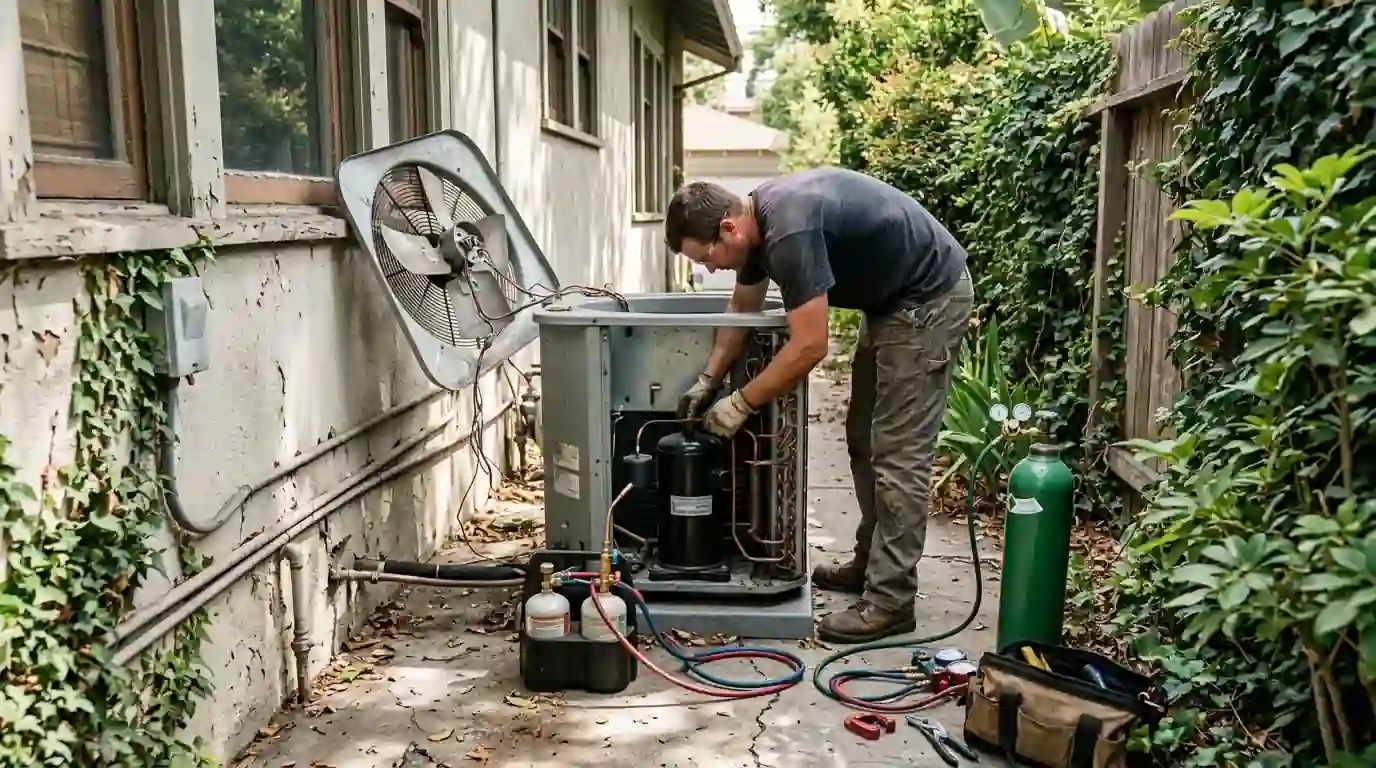
Before replacing an AC compressor in Pasadena, Marco's confirms it has actually failed by testing the windings with an ohmmeter, checking for a short to ground, and ruling out a bad capacitor, contactor or tripped internal overload. If the compressor is truly done, we recover refrigerant, braze in the new compressor and filter drier, pull a deep vacuum, and recharge by weight, after you approve the quote.
AC Compressor Replacement
The compressor is the pump at the heart of your air conditioner. It squeezes refrigerant gas from low pressure to high pressure, which is what lets the system move heat from inside the house to outside. When it stops, nothing else matters. The fans spin and the air moves, but nothing gets cold.
A dead compressor is one of the most expensive AC repairs, and it is also one of the most misdiagnosed. A compressor that will not start may simply have a failed capacitor or an overheated internal overload that needs time to reset. Our technicians test carefully before calling it, because the difference between a $250 repair and a $3,000 one is worth an extra half hour of testing.
Warning signs
The compressor tries to start, hums loudly, and trips off on its internal overload. This can be a locked rotor or a failed start component. Testing tells the two apart.
The outdoor fan spins and the indoor blower runs, but the suction line stays warm. The compressor is not pumping, either because it is not starting or has internal damage.
A compressor with a shorted winding or a short to ground can trip the breaker within seconds of starting. Resetting it repeatedly can damage wiring and the panel.
Grinding, banging or a metallic rattle from inside the outdoor unit can mean broken internal parts, a loose mount or valve damage. It usually gets worse quickly.
An acrid electrical odor near the outdoor unit can come from an overheating compressor winding or burned terminal connections. Shut the system off and call.
A compressor drawing well above its rated load amps on a hot day may be wearing internally or fighting high head pressure from a dirty coil or overcharge.
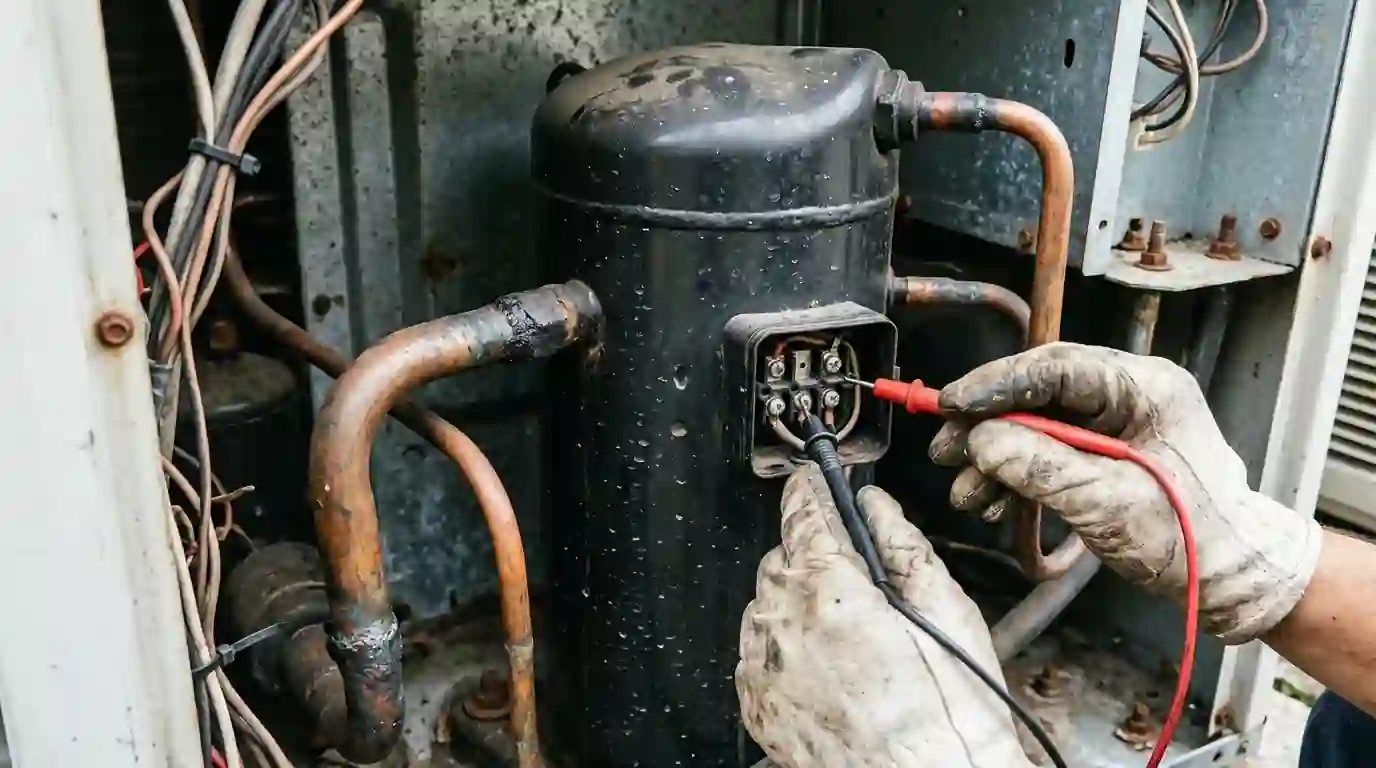
Compressor failure falls into two groups: electrical and mechanical. Electrically, the motor windings can open, short to each other or short to the metal shell. We measure resistance between the common, start and run terminals and compare against expected values, then check each terminal to ground with a meter. A reading to ground means the compressor is done.
Mechanically, the valves or scroll can wear or break, so the compressor runs but does not pump. We see this as low head pressure, high suction pressure and low amperage on the gauges. Locked rotors draw very high current and never start. Before condemning a locked compressor, we try a hard-start kit or a new capacitor, since a weak start can mimic a seized motor.
Compressors rarely just wear out. Something kills them. Common causes include long-term low refrigerant charge, which cuts the cooling gas returning to the motor; a dirty outdoor coil that drives head pressure and heat up; liquid refrigerant flooding back from a frozen coil; and a failing capacitor that makes every start a struggle. Acid from a burnout can also stay in the system and damage the replacement.
That is why our replacement is more than swapping the part. We find and fix the root cause, whether that is a leak, a weak fan motor or a dirty coil. After a burnout, we test the oil for acid, install a suction line filter drier if needed, and replace the liquid line drier so the new compressor starts clean.
On a system under 10 years old with a manufacturer parts warranty still in force, replacing the compressor alone usually makes sense. The part may be covered, leaving labor, refrigerant and drier costs. If the equipment was registered with the manufacturer, that registration matters here.
On an older system, or one using R-22, a new compressor goes into a cabinet with an aging coil, fan motor and controls. Replacing the whole condenser and indoor coil with a matched SEER2 system using a current A2L refrigerant often costs not much more and starts a fresh service life. We price both options so you can decide.
Step by step
We test the windings, ground, capacitor and contactor, then read pressures and amperage during a start attempt to confirm the compressor has failed.
You get a price for compressor replacement and for a matched condenser and coil, with warranty status checked when the equipment was registered.
Refrigerant is recovered, the old compressor is unbrazed and removed, and the system is checked for acid or burned oil that needs cleanup.
The new compressor is brazed in while dry nitrogen flows through the lines to prevent scale, with a new filter drier and capacitor installed.
We pull a deep vacuum below 500 microns, charge by weight, then confirm amperage, superheat, subcooling and cooling performance under load.
Typical prices
Compressor replacement is a large repair because of the part cost, refrigerant and labor. These typical 2026 ranges cover Pasadena and nearby San Gabriel Valley cities. Warranty status can change the total a lot. The final price comes after testing, and we quote it before the work starts.
| Job | Typical range | What is included |
|---|---|---|
| Compressor testing and diagnosis | $149 to $238 | Winding, ground, start component and pressure tests with a written quote |
| Hard-start kit or capacitor upgrade | $237 to $486 | Fixes some no-start cases without replacing the compressor |
| Compressor replacement, part under warranty | $1,385 to $2,765 | Labor, refrigerant, filter drier, nitrogen purge and vacuum |
| Compressor replacement, part not covered | $2,640 to $4,315 | Varies with tonnage, compressor type and refrigerant cost |
Price moves with system size, single-stage versus two-stage or variable-speed compressors, refrigerant type and whether burnout cleanup is needed. Factory compressors for variable-speed systems cost noticeably more than standard scroll units. Compare other jobs in our Pasadena HVAC price guide.
Pasadena summers push compressors hard. Afternoons in the high 90s and over 100 degrees mean long run times and high head pressure, especially for condensers sitting in full sun on a south or west wall. Units squeezed into narrow side yards between houses, common in older neighborhoods like Garfield Heights and Lamanda Park, often recirculate their own hot exhaust air, which makes the compressor work even harder.
Many compressor failures we see during heat waves started with something small: a capacitor that was weak in spring, or a coil that never got cleaned after a Santa Ana dust storm. If your compressor was replaced recently, keep the outdoor coil clean and the area around the unit clear by two feet. That simple habit protects an expensive part from a repeat failure.
Related work
Warm air, a humming outdoor unit or a tripped breaker: we find the failed part and fix most AC problems in one visit.
Learn moreSwap a worn-out air conditioner for a correctly sized SEER2 system, with duct testing and permit work handled in one job.
Learn moreWe trace refrigerant leaks with electronic detectors, bubble tests and nitrogen pressure, then repair and recharge by weight.
Learn moreA spring tune-up that cleans the coils, tests the capacitor and contactor, clears the drain and checks the charge before summer hits.
Learn moreOur technicians handle this work all over Pasadena and the surrounding San Gabriel Valley. A few of the places we cover:
Questions
From the outside, they can look the same: the unit hums or clicks but does not cool. A technician has to test. We check the capacitor's microfarads, the contactor, and the compressor windings and ground. A failed capacitor is a modest repair. A shorted or open winding means the compressor itself has failed.
Many compressors carry a parts warranty of several years, sometimes longer when the equipment was registered with the manufacturer after installation. Warranties usually cover the part only, not labor or refrigerant. We look up the serial number and registration status during diagnosis so you know where you stand before deciding.
Once the compressor is on hand, the replacement usually takes five to eight hours, including recovery, brazing, vacuum and recharge. Warranty compressors may take a few days to arrive from the distributor. If you are without cooling during a heat wave, ask about temporary options while you wait.
Usually not. R-22 compressors are harder to find, and the system must be recharged with reclaimed R-22 at a high price. The rest of an R-22 system is typically 15 years old or more. In most cases, a new matched system with a current refrigerant is the better use of the money.
Keep the outdoor coil clean, change filters on schedule, and have the system tuned each spring so the capacitor and charge get checked. Make sure the area around the condenser stays clear for airflow. If the cause of the first failure was a leak or a weak fan motor, we fix that during the replacement.
Call our Pasadena line any hour. A person answers, asks a few questions about the system, and gives you an arrival window.